
High School
Graduation and Dropout
High School Graduation and Dropout: The Critical Milestone
High school graduation is an essential milestone that shapes students’ life outcomes and the well-being of their communities.19 Failing to graduate or dropping out limits job opportunities and increases economic vulnerability, as individuals without a diploma face greater challenges securing stable, full-time work.20
A report from the Healey-Driscoll administration highlights this gap, showing that Massachusetts graduates earn significantly more over a lifetime than non-graduates, with even greater earnings for those who complete postsecondary credentials.21 Yet graduation and dropout prevention depends on far more than schools alone: It requires that students feel safe and welcomed, that mental health needs are addressed, and that they have stable housing, food security, and supportive adult mentors who encourage persistence. It also depends on whether students can envision a path forward and have the support to pursue it. Graduation, then, is not just an academic achievement; it reflects coordinated support across schools, families, health systems, and communities. While Boston has made progress in improving graduation rates and reducing dropout, persistent disparities, particularly for multilingual learners, students with disabilities, and students of color, show the system is not working equally for all students.
How Are Boston High School Students Doing?
Graduation Rates
High school graduation rates hit an excellent milestone in SY 2024–25, reaching the highest rates for BPS (81.3 percent) since tracking began in 2006. This milestone achievement is evidence of the progress made by the aligned efforts of the BPS superintendent, the College and Career Life Readiness team, and scores of educators and community partners that wrap around the students to support their journeys to success. Graduation rates by race/ethnicity and gender have improved in recent years, narrowing some gaps. However, disparities persist: Asian and White female students continue to graduate at the highest rates, while Black and Latino male students remain at lower rates. The data also show substantial gains for low-income students over time, narrowing gaps with the overall student population. Yet disparities persist. Multilingual learners and students with disabilities continue to graduate at lower rates than their peers, indicating ongoing subgroup disparities despite overall progress. These disparities signal that while schools are succeeding in graduating many students, that success is not universal.


Dropout Rates
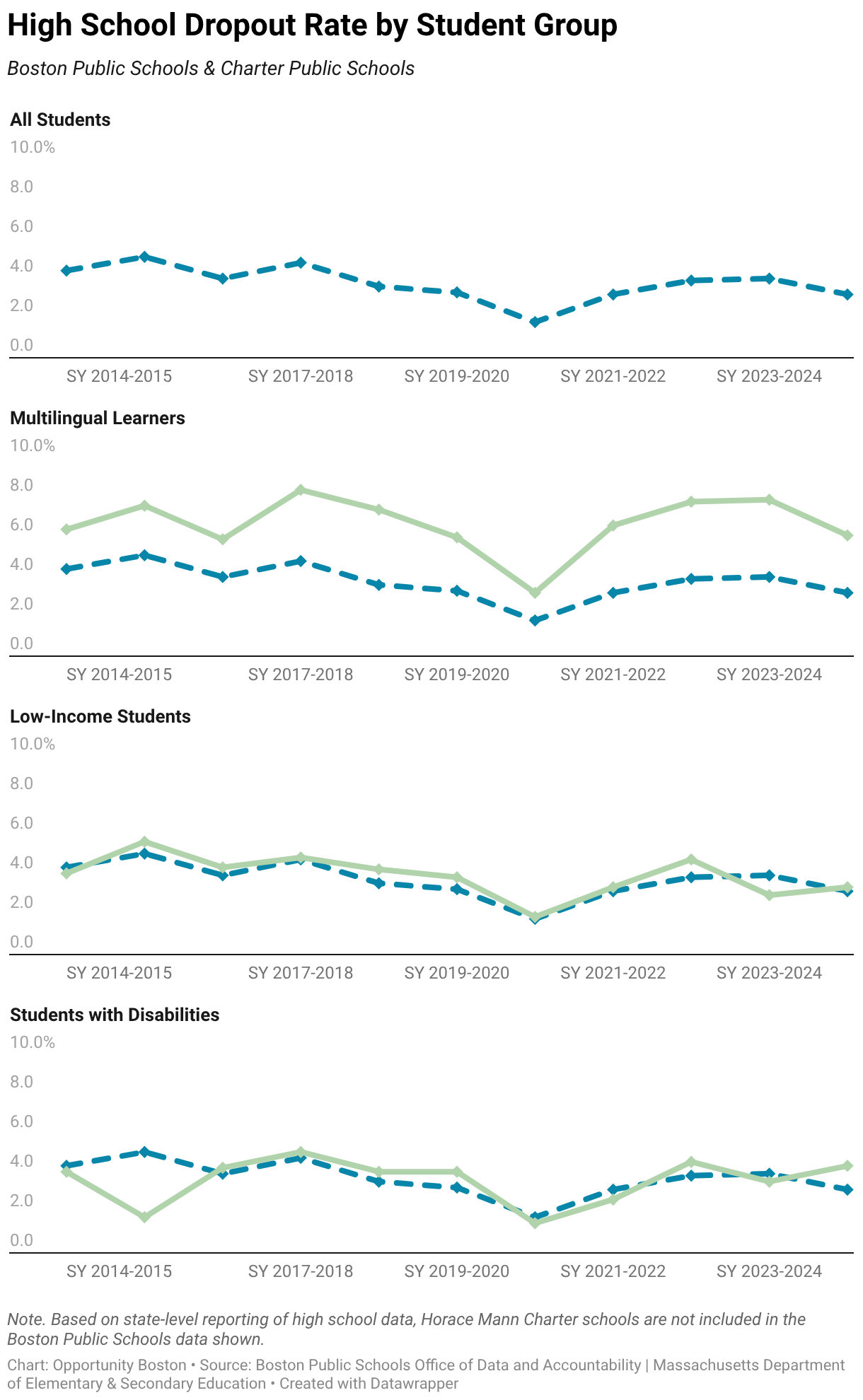
Dropout rates among Boston high school students are relatively low and have fluctuated over time. Rates declined steadily prior to the pandemic, reaching a low of 1.8 percent in SY 2020–2021, then increased after the pandemic to 4 percent in SY 2023–2024 before declining again to 3.2 percent in SY 2024–2025. This decline during SY 2020–2021 was also observed among multilingual learners, low-income students, and students with disabilities. By SY 2024–2025, rates for multilingual learners have decreased, while those for low-income students and students with disabilities have slightly increased. Across racial and ethnic groups, overall dropout rates have declined, with notable decreases among Black or African American students, particularly males, whose rate fell from 5.4 percent in SY 2023–2024 to 2.8 percent, and among Asian students, whose rates remain very low. Latino students continue to have higher rates, especially males at 5.7 percent. These trends underscore the ongoing need for targeted initiatives to address persistent disparities. This tells us: The system has improved at keeping many students in school, but for students facing intersecting barriers, including language challenges, disability, racism, and economic stress, the system needs to adapt.

What Is Being Done to Support Boston High School Students?
Boston’s approach to supporting graduation has evolved to recognize that schools cannot do this alone. Graduation requires coordinated efforts across schools, health systems, community organizations, and families with intentional focus on the students most at risk. Boston has begun implementing initiatives aimed at expanding inclusive classrooms and increasing cultural competency among staff and access to bilingual programming. These efforts ensure that multilingual learners and students with disabilities can learn alongside their peers while receiving the language development and instructional support necessary to succeed.
Pathway Programs
As detailed in the previous section, expanded college- and career-focused programs and practices that promote students’ college, career, and life readiness are strongly associated with higher persistence and graduation rates. One key component of such support is providing students with opportunities for career-connected learning, such as internships and summer jobs, helping them gain real-world experience and clarify their postsecondary and career aspirations. This is especially important for dropout-risk students who feel they do not belong in school because the curriculum and teaching do not reflect their language, culture, or abilities. Ensuring inclusive, culturally responsive classrooms where students receive targeted instructional and language support, have access to opportunities that connect learning to their interests and goals, and engage in college- and career-connected experiences is central to preventing dropout and promoting persistence to graduation.
Re-Engagement
The district has also implemented multiple re-engagement strategies for students who have been disconnected from school. Through the Re-Engagement Center, a partnership between Boston Public Schools and Boston Private Industry Council, the district coordinates efforts to address student dropout, including counseling and summer door-knocking campaigns designed to reconnect with students who have previously disengaged from school. This has been paired with the district’s launching district-wide, cross-departmental recovery efforts focused on identifying and re-enrolling students who do not report (DNR) within the first two weeks of the school year. These efforts have resulted in the successful recovery and re-engagement of nearly 400 students annually across the district. Reconnecting students requires trust, cultural competence, and relationships that schools alone cannot provide. Community-based organizations like Boston Private Industry Council have deep relationships in neighborhoods and with families. They can reach students and families that schools might not.
Opportunity Youth Collaborative:
An Opportunity Boston & Boston Private Industry Council Initiative
The Opportunity Youth Collaborative, co-convened by Opportunity Boston and the Boston Private Industry Council since 2013, is a cross-sector initiative composed of representatives from Boston Public Schools (BPS), community colleges, alternative education programs, local community-based organizations, foundations, and city and state agencies working toward reconnecting 18–24-year-olds who have been disconnected from high school, postsecondary, and the workforce. The collaborative focuses on systems change by aligning education, workforce, and career exploration programs so that young people can more easily navigate career paths and avoid becoming disconnected in the first place. Partners prioritize an equity-minded approach that centers youth voice, shared data, and collective advocacy to identify barriers and pilot new strategies that can be scaled across the city.
Through coordinated efforts, the collaborative works to expand career exploration opportunities, increase access to high-quality occupational training and pre-apprenticeships, strengthen mentorship and advising supports, and address barriers such as housing insecurity, mental health needs, and child care that often prevent young adults from progressing in education or employment. By bringing together partners across sectors, the collaborative helps ensure that opportunity youth have clear on-ramps to training, college, and employment while empowering young people themselves to shape the policies and programs designed to support their success.
Spotlight: Boston Public Schools Educational Options
In Boston, Educational Options allows students and families to select the school of their choice. This policy reflects recognition that not all students thrive in traditional schools. Some students need smaller settings, some need specialized curricula, some need flexible schedules. Across the network, schools and programs have engaged in intentional redesign to ensure greater coherence, equity, and impact.
Schools are intentionally designed to meet students where they are academically, linguistically, and socially while maintaining high expectations and clear trajectories toward graduation and postsecondary success. This includes expanding capacity and strengthening instructional practices to serve multilingual learners and students with individualized education programs, while deepening social-emotional and wraparound support through collaboration among general education teachers, special educators, and related service providers.
To support this work, the city developed a central school enrollment portal in partnership with Boston Public Schools and the Office of Early Childhood, so that families with infants, children, and youth can explore schools through the Great Starts enrollment platform, where they can review key features and make informed enrollment decisions. This policy and collaborative infrastructure are significant because they recognize a key driver of disengagement: school fit. When students feel their school doesn’t match their interests or needs, they are far more likely to disengage. Choice, paired with intentional school redesign, increases the likelihood that students will find a setting where they can succeed.
Where Is More Support Still Needed?
Trends in graduation and dropout rates show that underserved student populations remain at greater risk, reflecting challenges that extend beyond the classroom. With many students facing economic disadvantage, barriers such as mental health needs, housing and food insecurity, transportation challenges, and language access continue to undermine consistent attendance and academic engagement, underscoring the importance of social and emotional support as a foundation for success. Boston Public Schools’ multilingual learners, for instance, are showing strong growth in English proficiency, earning a 3 out of 4 on the state’s progress scale in non–high school grades and a 4 out of 4 in high school. This demonstrates how targeted, coordinated efforts across schools, health systems, social services, and community partners can provide the comprehensive support students need to persist and graduate.
Why This Matters for the Full Pipeline and What’s Next for Boston?
Ten-year trends in high school dropout and graduation outcomes point to both meaningful progress and persistent inequities. While dropout rates remain relatively low overall and graduation rates have stabilized post-pandemic, increases in dropout, particularly among multilingual learners, signal renewed risk for students facing linguistic and structural barriers. Students who require more time to attain English proficiency are more likely to disengage and leave school before graduating.22 Students with disabilities and low-income students continue to experience graduation gaps, again indicating the need for coordinated, individualized support. In a rapidly changing economy where credentials matter more than ever, a high school diploma is an achievement, but only the minimum. Graduation rates must not only remain stable but improve, with particular focus on closing gaps for the most vulnerable students.
What's next:
- Deepen coordination of mental health support. Mental health is the most consistently identified barrier to graduation. This requires increasing the in-school and out of school supports for students, including embedded school-based mental health providers, partnerships with community mental health organizations, and increased training for all school staff to recognize and support students in crisis.
- Address basic needs insecurity. Schools cannot expect students to focus on academics when they don’t know where they’ll sleep. It is necessary that Boston build on current efforts to increase school partnerships with social services, nonprofits, and community organizations to ensure every student has food security, housing stability, and access to health care.
- Increase investments to provide more intensive support for highest-risk students. We can leverage structures and supports, including the Multi-Tiered System of Support (MTSS), to identify students most at risk and provide intensive, personalized support, such as case management, mentorship, flexible scheduling, and coordinated services.
While high school graduation is a milestone, it is also a transition point, the launch toward college, career, and economic self-sufficiency. Students who graduate without clear guidance or support often flounder in the transition to postsecondary education and work. Students who participate in Pathway Programs that provide mentors and relationships are far more likely to persist and succeed. This is why graduation is not just a school goal. It is a shared responsibility of all of us, including health systems that support mental health, social services that address basic needs, community organizations that provide mentorship and engagement, employers who create career opportunities, and families, to ensure that every Boston high school student graduates prepared to succeed in the next phase of their life.
Notes:
19. StriveTogether. (2025). Cradle-to-Career outcomes playbook: High school graduation. StriveTogether. https://www.strivetogether.org/wp-content/uploads/2025/08/StriveTogether-Cradle-to-Career-Playbook_HSG_Final.pdf
20. National Center for Education Statistics. (2024, May). Annual earnings by educational attainment. U.S. Department of Education, Institute of Education Sciences. https://nces.ed.gov/programs/coe/indicator/cba
21. Commonwealth of Massachusetts. (2025, November 19). Mass degrees deliver: New report highlights economic impact of Governor Healey’s college affordability investments. Commonwealth of Massachusetts. https://www.mass.gov/news/mass-degrees-deliver-new-report-highlights-economic-impact-of-governor-healeys-college-affordability-investments
22. Gonzalez et al., 2022.