
Postsecondary Enrollment
and Completion
Postsecondary Enrollment and Completion: Credentials and Economic Opportunity
Earning a postsecondary credential is a key driver of economic opportunity and social mobility, with the overwhelming majority of jobs projected through 2031 requiring education or training beyond high school.23
The Massachusetts Department of Higher Education released a report highlighting that individuals who complete a bachelor’s degree at four-year public universities in Massachusetts earn, on average, $20,000 to $30,000 more annually than those with only a high school diploma.24 Yet the benefits extend beyond earnings: Postsecondary attainment strengthens communities by reducing unemployment, increasing civic engagement, and improving health outcomes.25,26For low-income students, students of color, and first-generation students, postsecondary credentials are often the difference between economic vulnerability and stability. However, enrollment alone is not enough as many students who begin college do not complete it, representing lost opportunity and unfulfilled potential. Supporting completion, not just enrollment, requires partnerships with higher education institutions, with employers, with support services, and with families. It requires removing barriers before students enroll and providing sustained support throughout their education.
How Are Boston Graduates Doing?
Postsecondary Enrollment
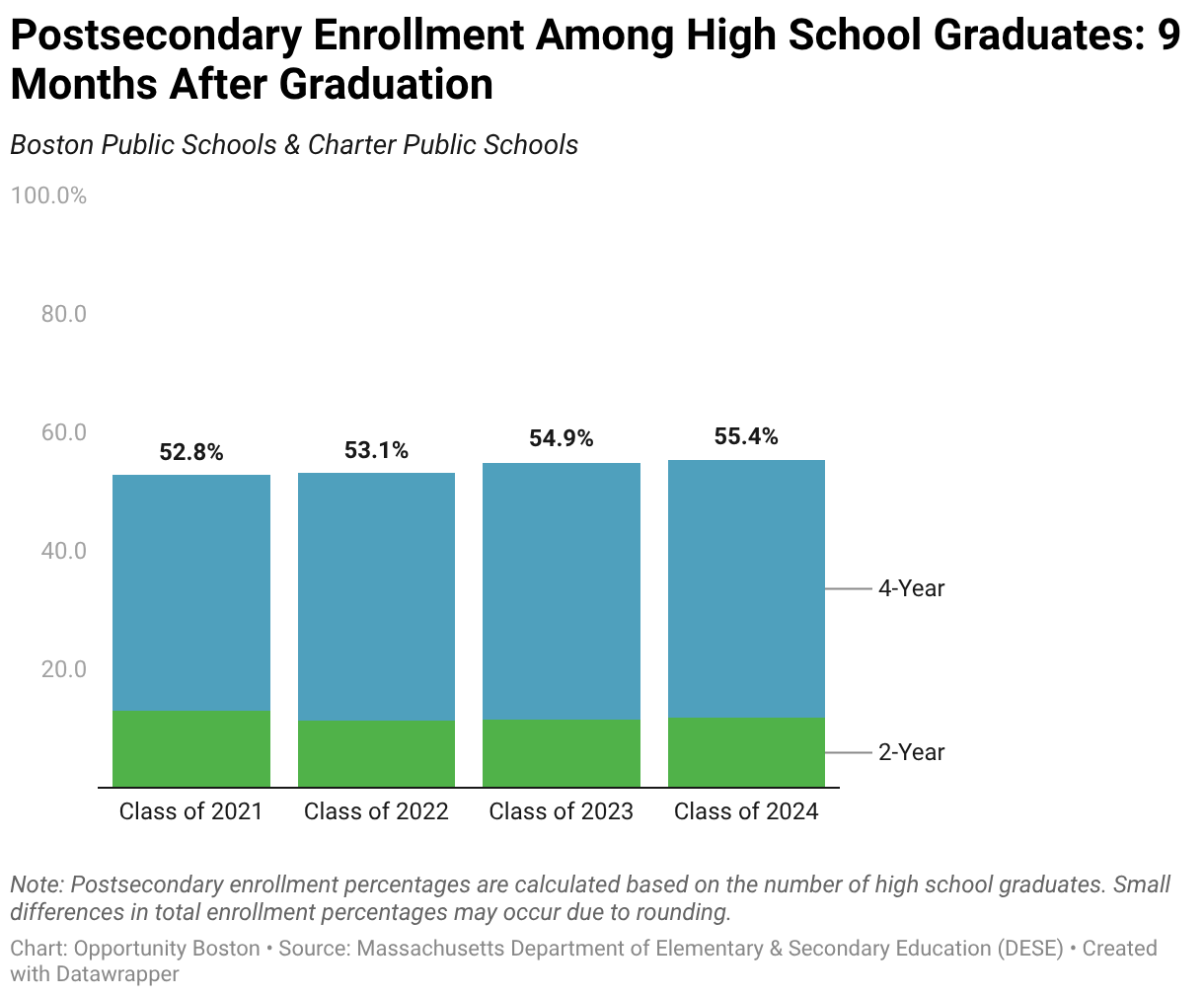
Postsecondary enrollment and completion for Boston students show modest improvement over the past four years. Postsecondary enrollment within nine months of high school graduation increased from 52.8 percent for the Class of 2021 to 55.4 percent for the Class of 2024. Enrollment for the Class of 2021 was lower than in prior years due to the impacts of the COVID-19 pandemic but has increased for more recent graduating classes.27 Students continue to enroll at higher rates in four-year institutions than in two-year institutions. Four-year enrollment rose from 39.8 percent to 43.6 percent over this period, while two-year enrollment declined slightly from 13.0 percent to 11.8 percent. Among graduates attending institutions in Massachusetts, the largest share enrolls at University of Massachusetts campuses, followed by Massachusetts community colleges and state universities. The increase in four-year enrollment is positive, as four-year degrees generally provide greater economic returns. Yet the overall enrollment increase hides important details: Which Boston students are enrolling? Are all demographic groups represented equally? Are students being supported to persist and complete?

Postsecondary Completion
This is where the data become more sobering. Completion rates have shown modest trends: Historical data tracking six-year postsecondary completion for high school graduating classes who enrolled in college from 2014–2017 show a slight increase, rising from 52.7 percent to 56.9 percent before declining to 54.1 percent in 2017. Nationally, six-year college completion rates show a similar pattern of gradual change, increasing from 59.4 percent for the class of 2014 to 61.1 percent for the class of 2017.28 While Boston’s rates remain below the national average, the overall trend mirrors the modest year-to-year fluctuations seen across the country. The critical reality: Slightly over half of Boston graduates who enroll in college 16 months after high school graduation complete their degree program within six years, meaning roughly half of students who enroll do not finish. For many, this represents years of tuition costs, student loans, and lost opportunity without the credential that provides economic return. For Boston's low-income students, this can mean a lifetime of debt without the earnings boost a degree provides.

What Is Being Done to Support Boston Graduates?
Boston’s approach to postsecondary enrollment and completion is fundamentally a partnership approach, recognizing that success requires alignment across high schools, higher education institutions, employers, workforce development organizations, and support services. Several state policy efforts have been made to reduce barriers to enrollment and completion.
MassReconnect, originally aimed at providing free community college for individuals 25 and older, has been expanded as MassEducate, so that graduates who are U.S. citizens and have lived in the state for at least a year, regardless of age and income, can attend community college tuition-free. The state also covers fees for eligible students, with additional funding provided for low-income students to cover ancillary costs through MassEducate. Further, MassGrant Plus provides funding to low-income students to attend community colleges or enroll full-time at public four-year institutions across the Commonwealth.
The Supporting Urgent Community College Equity through Student Services (SUCCESS) fund complements these efforts by providing Roxbury Community College and Bunker Hill Community College with financial resources to offer personalized, wraparound support for underserved students, recognizing that affordability alone is not enough; students need guidance, mentorship, and support to navigate systems and persist. These state policies remove key barriers, such as cost and lack of information, but also demonstrate an important principle: Higher education affordability reforms must be matched with stronger student supports, because money alone does not ensure completion.
At the local level, citywide initiatives bring together high schools, colleges and universities, community organizations, and workforce partners to support students in enrolling and succeeding in college. Initiatives like New Skills Boston and Success Boston coordinate between high schools and postsecondary institutions to help students navigate their next steps with clarity and support. Early College Pathway Programs allow students to earn college credits while still in high school, building momentum toward completion, while MyCAP (My Career and Academic Plan) extends into postsecondary planning to support realistic, guided paths from high school through college and into career. Partners also recognize that completion is only meaningful if it leads to career opportunity, so community colleges, universities, and employers work together to align credential programs with labor market demand and ensure students understand how their credential translates into employment.
Spotlight: Success Boston, an Opportunity Boston Initiative
Success Boston, convened by Opportunity Boston, is the flagship citywide college completion initiative bringing together the Boston Foundation, the City of Boston, Boston Public Schools, the Boston Private Industry Council, local higher education institutions, and community nonprofits around a shared goal: 70 percent completion within six years of graduation. Since its establishment in 2008, through both supporting direct coaching services and building the networks around them, Success Boston has contributed to boosting the college completion rate to its current level. As part of this work, Success Boston has built structures like the Success Boston Coaches Network, supporting professional coaches at nonprofits, high schools, and higher education institutions who work directly with students. Additionally, Success Boston has developed strategies for sharing data between high schools, community-based organizations, and higher education institutions, to track progress and direct efforts at systems change.
Central to this effort, Success Boston also continues to serve as a learning community for higher education leaders. Through the Institutes of Higher Education Community of Practice, Success Boston convenes over a dozen local institutions of higher education (IHEs), including public, private, and community colleges. In January 2026, 50 higher education representatives convened to explore data, student and institutional perspectives, enrollment barriers, and strategies to support persistence and completion. Bringing together cross-functional teams from each partner institution, the community of practice provides a space for IHEs to identify and address barriers to student success; align data needs; build connections; and learn from experts, students, and one another. Colleges that coordinate in this way can identify patterns, share solutions, and improve outcomes together, because completing college is not an individual achievement, in fact, it is a system challenge.
Spotlight: Future Beacon Option
University of Massachusetts Boston has partnered with Bunker Hill Community College (BHCC) and Roxbury Community College (RCC) to support students transferring into UMass Boston. The Future Beacon Joint Admissions Program at BHCC allows students to have dual access to resources, as well as dedicated financial aid and waivers for submitting the UMass Boston enrollment deposit. Similarly, the Future Beacon Option at RCC simplifies enrollment at RCC and the transfer to UMass Boston in a future semester, removing transfer fees to make the process more accessible. These partnerships remove barriers by providing joint admissions access, dedicated financial aid and fee waivers, simplified enrollment, warm handoffs between advisors, and personalized guidance during transitions. By coordinating support in this way, students feel more supported and are less likely to disengage during the critical transition from community college to a four-year institution: a point at which many students are at risk of dropping out. By offering financial support, clear avenues, and personal connections, Future Beacon ensures that students do not fall through the cracks.
Where Is More Support Still Needed?
Slow progress toward citywide college enrollment and completion goals shows that many students, particularly those from underserved backgrounds, face significant barriers. Only 55.4 percent of Boston graduates enroll in college, and of those, nearly 46 percent do not complete, reflecting obstacles such as limited information about college and financial aid, upfront costs, competing responsibilities, academic preparation gaps, and lack of family experience with higher education. Challenges to completion include gaps in foundational skills, insufficient academic support, mental health and social-emotional barriers, unclear connections between coursework and careers, and a lack of a sense of belonging, particularly for students of color. Addressing these gaps requires early college awareness, guidance on navigating financial aid, exposure to career paths, family engagement, and coordinated supports in academics, counseling, mentoring, and finances to ensure students not only enroll but persist and succeed.
Why This Matters for the Full Pipeline and What’s Next for Boston?
Postsecondary enrollment and completion represent the culmination of the cradle-to-career pipeline. Students who complete credentials gain access to many well-paying jobs. Students who don’t complete face years of debt and limited economic opportunity. Yet completion is not just an individual challenge; it’s a systems challenge. When students enter college unprepared, when they navigate colleges that don’t know how to serve them, when they work full-time while attending classes, when they lack financial support and mentorship, they are unlikely to complete. These are not failures of student motivation; they are failures of system coordination. As artificial intelligence and automation reshape the economy, credentials will become even more important for economic security. The gap between credential holders and non-holders will widen. Boston’s low-income students, students of color, and first-generation students face the greatest risk of being left behind.
When students enter college unprepared, when they navigate colleges that don’t know how to serve them, when they work full-time while attending classes, when they lack financial support and mentorship, they are unlikely to complete. These are not failures of student motivation; they are failures of system coordination.
What's next:
- Deepen high school preparation. Students entering college need strong academic fundamentals. Ensure all Boston high school students, particularly those from underserved backgrounds, have access to rigorous coursework and support to succeed.
- Scale early college awareness. Partner with community organizations to reach more families, particularly first-generation families, with information about college and career options and resources.
- Expand affordability programs. Building on state investments like MassEducate and MassGrant Plus, advocate to ensure all Boston students can afford college. For low-income students, this may mean covering not just tuition but living costs and books.
- Provide integrated academic support in college. Not all students need remediation, but many need support in foundational skills. Provide this support within college-level coursework, not only as a separate track or service to navigate.
- Provide wraparound holistic supports. To ensure that more students succeed through completion, connect them with high-quality coaching services, in both CBO and higher education settings. Coaching helps students navigate a variety of non-academic challenges, related to financial aid, course selection, career advising, and time management—and has been proven effective in increasing completion.29
- Align college programs with workforce demand. Ensure that credentials students earn actually lead to employment. Partner with employers to understand in-demand skills and adjust college programs accordingly.
- Make data visible and actionable. Following Success Boston’s model, track which Boston students enroll at which institutions, what their completion rates are, and what barriers they face. Use this data to identify problems and solutions.
College and postsecondary training completion is not truly the end, it is the launch. Students who complete credentials enter the workforce with economic opportunity and power. Students who don’t face vulnerability and limited choice. This is why postsecondary completion is not just a student goal or an institution goal. It is a shared responsibility of all of us, including high schools that prepare students, colleges that educate them, employers who hire them, foundations that fund support services, community organizations that provide mentorship, families that encourage persistence, and city government that removes barriers, to ensure that every Boston student who aspires to college can access it, afford it, and complete it, regardless of family income or background.
Notes:
23. Carnevale, A. P., Smith, N., Van Der Werf, M., & Quinn, M. C. (2023). After everything: Projections of jobs, education, and training requirements through 2031. Georgetown University Center on Education and the Workforce. https://cew.georgetown.edu/wp-content/uploads/Projections2031-National-Report.pdf
24. Ortega, N., Dannenberg, M., Delci, M., & Glick, M. (2025, November 19). The earnings outcomes of public postsecondary education in Massachusetts. Massachusetts Department of Higher Education. https://www.mass.edu/datacenter/2025earningsreport.asp
25. StriveTogether. (2025). Cradle-to-Career outcomes playbook: Postsecondary enrollment. StriveTogether. https://www.strivetogether.org/wp-content/uploads/2025/09/StriveTogether-Cradle-to-Career-Playbook_PSE_Final.pdf
26. StriveTogether. (2025). Cradle-to-Career outcomes playbook: Postsecondary completion. StriveTogether. https://www.strivetogether.org/wp-content/uploads/2025/11/StriveTogether-Cradle-to-Career-Playbook_PSC_Final.pdf
27. McLaughlin, J. (2023, March 23). College enrollment and completion: Trends for Boston Public School graduates. Success Boston. https://www.tbf.org/-/media/tbf/reports-and-covers/2023/bps-college-enrollment-and-graduation-trends-2023.pdf
28. National Student Clearinghouse Research Center. (2025, December 4). Yearly progress and completion. National Student Clearinghouse Research Center. https://nscresearchcenter.org/yearly-progress-and-completion/
29. Abt Associates. (2023). Coaching for completion: Final report for Success Boston coaching. The Boston Foundation. https://www.tbf.org/-/media/tbf/reports-and-covers/2023/success-boston-power-of-coaching-report-2023.pdf